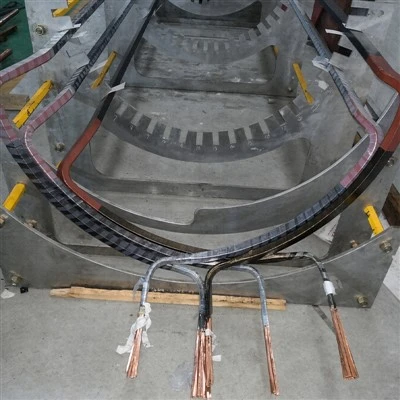

Stator bar electrical joint welding can employ a dual cooling method of air cooling and water cooling. During welding, a temperature measuring device monitors the temperature around the weld, and air cooling is used for cooling. When the temperature exceeds 100°C, water cooling is activated. After welding, air cooling is used for drying and slow heat treatment to prevent insulation damage and improve welding efficiency.
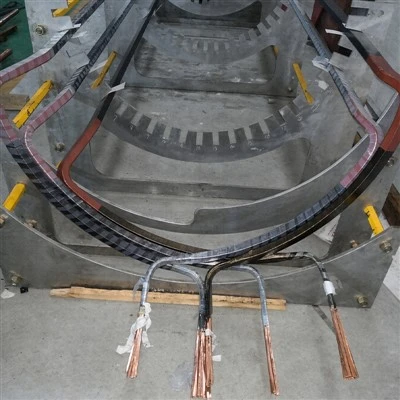
To reduce circulating current losses, stator bars often employ Roebel transposition technology, where the strands twist once in the slot, causing the leakage inductance potential in the slot to cancel each other out. Transposition methods include insufficient transposition, empty transposition, and extended transposition, and their optimized design must consider factors such as copper loss. Research on the electric field of stator bar insulation structures mainly focuses on three areas prone to corona discharge: the slot, the inner shield, and the bar ends. Studies show that when using a side-corrugated plate insulation structure, the highest potential of the anti-corona layer is lower than when using a pad-type structure; the inner shield structure with a low-resistance band and an external copper strip is a more effective insulation structure.